Mechanical Textile Recycling: Why the Process Chain from Tearing to Yarn Is the Key to Real Circularity
Mechanical textile recycling turns used textiles back into spinnable fiber and yarn through purely physical processing — no chemical dissolution required. It is the fastest-scaling path to circular textiles today, but its output quality depends almost entirely on how well fiber damage is controlled during the tearing stage.
That one sentence is the answer most people are searching for. Everything below explains why it’s true, where the technology currently stands, and what it takes to turn recycled fiber into yarn a mill will actually run.
The Untapped Resource: 1 Million Tonnes a Year, and Counting
Germany alone collects roughly 1 million tonnes of used textiles every year. According to a June 2026 trend report in Melliand Textilberichte (Stegschuster & Cetin), more than half of that volume still ends up in downcycling — think insulation material, wiping cloths, nonwovens — or in thermal recovery, i.e. incineration. Given how resource- and emissions-intensive textile production is, that is a lot of value being destroyed rather than recirculated.
The report’s core finding is encouraging: mechanical recycling is technologically ready. The bottleneck isn’t the concept — it’s execution. Specifically, it’s fiber shortening during the tearing process, and everything that shortening breaks downstream.
How the Mechanical Textile Recycling Process Chain Works
Mechanical recycling of textiles follows a defined sequence, sometimes called the “rag-to-yarn” or “tearing-to-yarn” chain:
- Sorting and pre-treatment — used textiles are sorted by fiber type and color, since mechanical recycling works best on relatively homogeneous input.
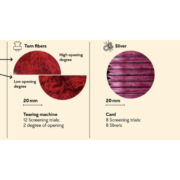
- Tearing — textiles are mechanically shredded back into a fibrous state. This is the highest-risk step: aggressive tearing shortens fiber length and increases neps, dust, and fiber breakage.
- Opening and blending — torn fiber is opened and typically blended with virgin or other recycled fiber to compensate for strength and length loss.
- Carding — fibers are aligned into a web. Carding performance is extremely sensitive to fiber length distribution, dust load, and fiber-to-fiber friction — all of which are set upstream at the tearing stage.
- Spinning — the carded sliver is drawn and spun into yarn. Weak, short, or high-friction fiber shows up here as breaks, uneven yarn, and low production speed.
The report frames this clearly: fiber length loss at step 2 is the single variable with the largest downstream impact on whether the final yarn is high-quality or barely spinnable.
Why Mechanical Recycling Isn’t “Just Good Enough for Downcycling”
There’s a persistent assumption in the industry that mechanically recycled fiber is inherently second-tier — suitable for nonwovens and insulation, not for apparel-grade yarn. The Melliand analysis pushes back on that. Done with the right process control, mechanical recycling can produce yarns that hold up against virgin fiber, at a fraction of the energy and water footprint of virgin fiber production or chemical (dissolving-pulp) recycling routes.
The determining factor isn’t the recycling method itself — it’s whether fiber integrity is protected at every step of the chain, starting with tearing.
Where Fiber Auxiliaries Come In: The LAMBAFIL® R Series
This is exactly the problem FiberLoop by AGATEX was built to solve with its LAMBAFIL® R Series, developed specifically for recycled raw materials. Four variants cover the main recycling feedstocks:
- LAMBAFIL® R100 — for synthetic-rich recycled material
- LAMBAFIL® R200 — for cotton and cellulosic recycled material
- LAMBAFIL® R300 — for PET-rich recycled material
- LAMBAFIL® R400 — for blended PET/cotton (“poly-cotton”) recycled material
Applied at the tearing and preparation stage, the LAMBAFIL® R Series reduces short-fiber content and dust generation and noticeably improves carding and spinning performance — enabling a higher achievable recycled content in the finished textile product. In short: LAMBAFIL® R doesn’t recycle the textile itself — it protects the fiber quality that mechanical recycling depends on, at the exact point in the chain where most of the damage happens.
AGATEX and the Recycling Atelier Augsburg
Since June 2024, AGATEX has been an industry partner in the network of the Recycling Atelier Augsburg (Technische Hochschule Augsburg / Institut für Textiltechnik Augsburg, ITA) — the world’s first model factory for mechanical textile recycling. The partner network comprises eleven industrial companies that together cover the entire mechanical textile recycling process chain. AGATEX contributes its process chemistry expertise, aimed at maximizing fiber length retention and recycling quality. More on the partnership and AGATEX’s circular-textiles products: agatex.at/textilesrecycling.
What It Will Take to Scale Circular Textiles
Mechanical recycling only scales if the whole chain works together:
- Mechanical recyclers need consistent, well-characterized fiber output
- Spinning mills need fiber and auxiliaries that run predictably on existing equipment
- Textile manufacturers need yarn quality they can specify against, not “recycled content” as a compromise
- Brands need traceable, verifiable circular material they can put on a label with confidence
None of these can solve fiber quality alone. It gets solved at the interface — tearing, carding, spinning — with the right process partners and the right auxiliaries.
FAQ: Mechanical Textile Recycling
What is mechanical textile recycling? Mechanical textile recycling is the physical processing of used textiles — tearing, opening, carding, and spinning — back into fiber and yarn, without chemically dissolving the polymer. It’s distinct from chemical/dissolving-pulp recycling methods.
Why does mechanical recycling produce lower-quality fiber? Not inherently — fiber quality loss comes primarily from mechanical damage during tearing, which shortens fibers and increases dust and breakage. With the right process control and fiber auxiliaries, mechanically recycled fiber can be spun into high-quality yarn.
How much used textile is available for recycling in Germany? Around 1 million tonnes per year are collected, per the June 2026 Melliand Textilberichte trend report — more than half currently goes to downcycling or thermal recovery rather than fiber-to-fiber recycling.
What does the LAMBAFIL® R Series do in the recycling process? The LAMBAFIL® R Series is AGATEX’s FiberLoop Technology fiber-auxiliary family for recycled raw materials, applied during tearing and preparation. It reduces short-fiber content and dust, and improves carding and spinning performance — with four variants for synthetic-rich (R100), cotton/cellulosic (R200), PET-rich (R300), and blended PET/cotton (R400) feedstocks.
What is the Recycling Atelier Augsburg? It’s the world’s first model factory for mechanical textile recycling, run by Technische Hochschule Augsburg and ITA Augsburg. A network of eleven industry partners — including AGATEX — together covers the full process chain from tearing through to finished recycled yarn.
Source: Stegschuster, G. & Cetin, M., “Prozesskette des mechanischen Recyclings vom Reißen bis zum Garn zur Herstellung hochwertiger Garne,” Melliand Textilberichte 3/2026, June 8, 2026. Read the original report.
More on AGATEX’s partnership with the Recycling Atelier Augsburg: agatex.at/textilesrecycling All AGATEX products for mechanical and chemical textile recycling and rPET fiber: agatex-fiberloop.com