A Spirit House for our location in Thailand

Our new location in Prachinburi has received a San Phra Phum—a Spirit House.

A custom we were happy to follow

Anyone traveling through Thailand sees them everywhere: small, meticulously maintained shrines next to houses, shops, and factories. A San Phra Phum, or Spirit House, provides a dwelling for the protective spirits of the land so that the people living and working there can do so in peace.

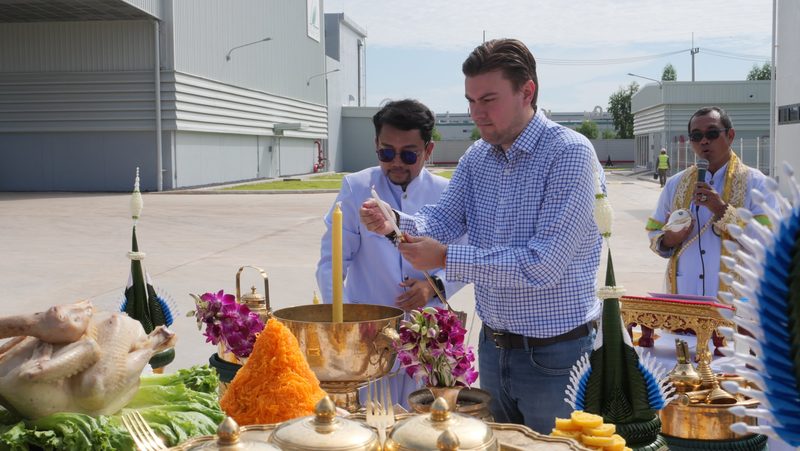
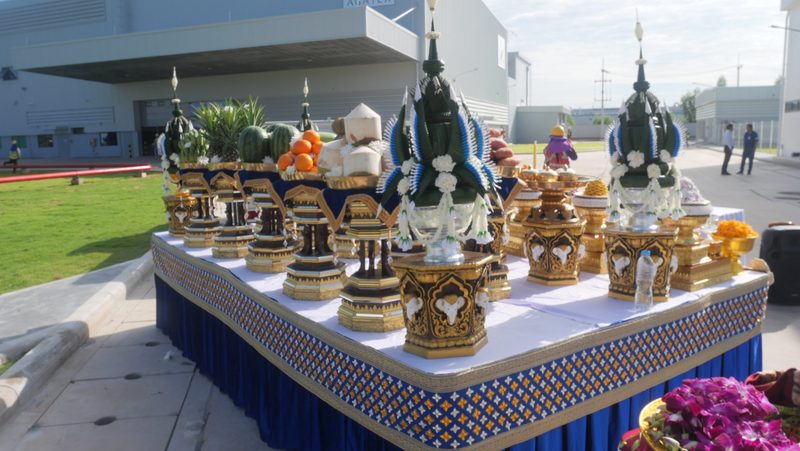
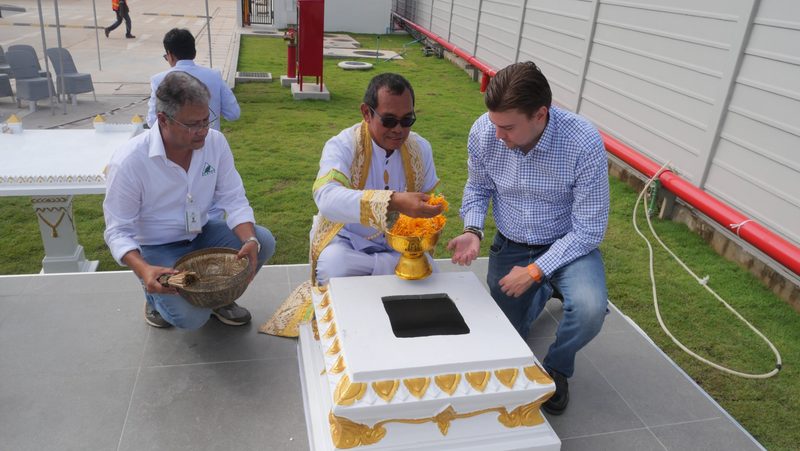
When a new site is built, the shrine is set up in a ceremony led by a Brahmin priest at a time determined to be auspicious. Offerings are prepared, candles and incense sticks are lit, and the land is blessed before work truly begins. For a company building in Thailand, participation is not a formality. It is a matter of respect—toward the place and toward the people who will work there.

The ceremony in Prachinburi

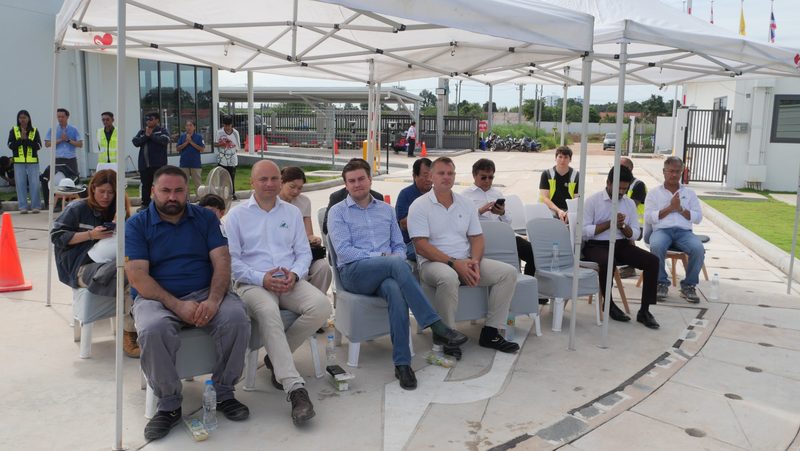
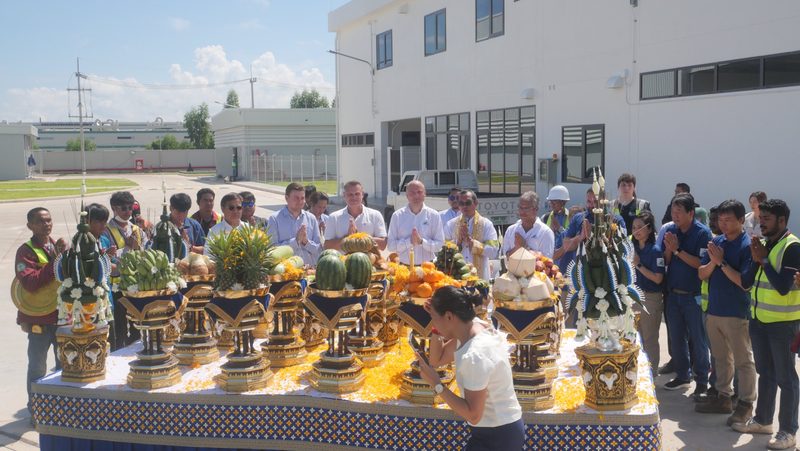
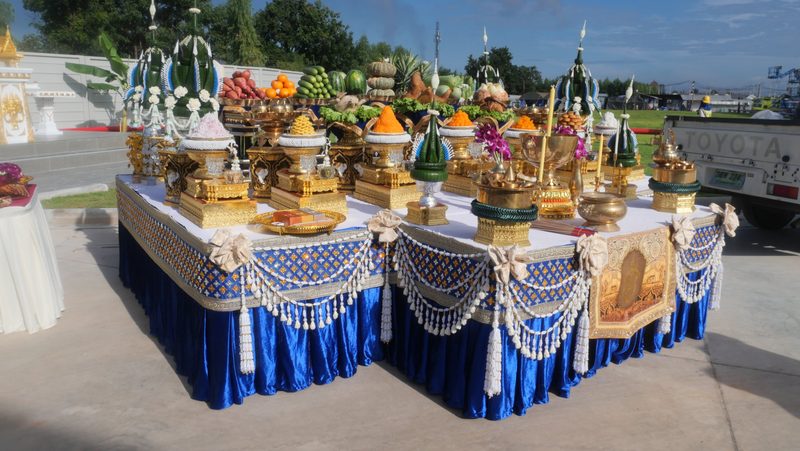
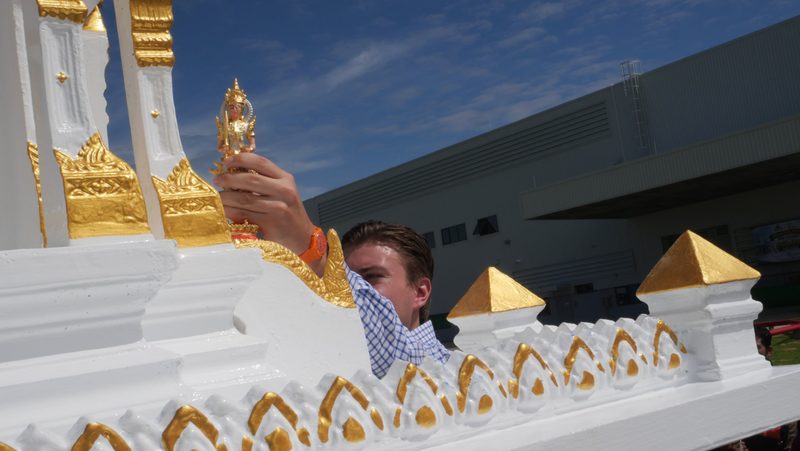
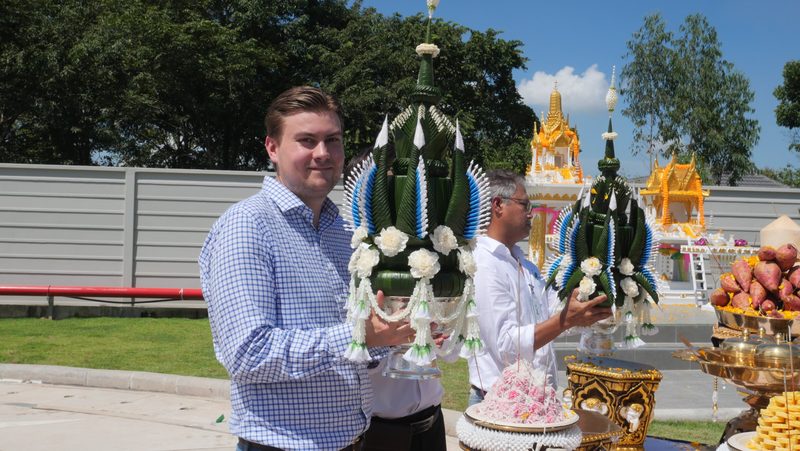
Our management, our Thai colleagues, and the construction teams who have been working on this site for months stood together for the blessing. The offering tables were set, the Bai Sri arrangements were carried to their places, and the protective figures were placed on the shrine in the order prescribed by the ceremony. Flowers were laid at the base stone, candles were lit, and the grounds were blessed.

It was a hot morning, and it was a good one. Many of the people around this shrine did not know each other before this project—Austrians, Thais, engineers, contractors. On this morning, they were simply the people building this plant.

Why this is important to us

AGATEX has been a family business since 1921, now in its fifth generation. We tend to think in decades rather than quarters—and that is exactly how we think about Thailand. Prachinburi is not just an address on an invoice; it will become our home in Asia.

Building a plant in another country is never just a technical project. It means understanding how things are done there—and participating instead of standing on the sidelines. The Spirit House is a small thing on the scale of a construction site. But it is the kind of detail that shows our Thai colleagues and neighbors how we intend to be present here.

One step closer

With this blessing, we are one step closer to our goal of producing for our customers in Asia. In the future, fiber, nonwoven, pulp, and paper manufacturers in the region will be supplied from Prachinburi—with shorter delivery times, local inventory, and on-site application technicians who can run trials on your equipment instead of describing them from Europe.

Our thanks go to everyone who participated in the ceremony and to the teams who have brought this location so far.

Tell us about your fiber, your equipment, and your target values—we’ll take care of the rest. Samples, trials, and joint development are possible at any time. Write to us at salesFC@agatex.at.
AGATEX at the Dornbirn Global Fiber Congress

AGATEX at the Dornbirn Global Fiber Congress

Process chemicals for the fibre industry — and an application lab to prove them. A look back at three days in Dornbirn, and at why close cooperation is the only way innovation happens in this industry.

Fibre chemistry, up close

The Dornbirn Global Fiber Congress is one of the few places where the entire fibre world sits in one room: producers, machine builders, research institutes and brand owners. That is exactly why we were there — to present our process chemicals for the fibre industry, and to talk to the people who actually run the lines.

Events like this matter more than their programme suggests. The fibre industry does not move forward in isolation. Everyone holds one piece of the puzzle, and progress only happens when those pieces get put on the table together.

What we brought with us

Our range covers the fibre process from spinning through to finishing:

Brand Application
LAMBAFIL® Spin finishes for staple fibre, filament and spunbond lines
LAMBAFIL® Hydrophilic agents for hygiene, wipes and absorbent applications
LAMBAPHOB® Hydrophobic agents for water-repellent technical textiles
LAMBAFELT® Antistatic agents for carding, needling and downstream handling
LAMEX® Defoamers for wet processes and finishing baths
CABERTEX® Flame retardants for technical and protective textiles


Our own application lab

A product list on its own does not solve anyone’s problem. What makes the difference is being able to test, adjust and reformulate before anything goes onto a production line. We run our own application lab for exactly that purpose: we reproduce the relevant steps of the process, measure the values that matter to the customer, and iterate until the result fits.

For hygiene applications that means strike-through, rewet, run-off, repeated liquid strike and surface tension. For spinning it means running behaviour, deposit formation and downstream processability. The data comes before the trial, not after it.

An extended workbench, not a catalogue

Many of our customers work with us the way they would work with an in-house development team — as an extended workbench. They bring us the fibre, the line parameters and the target values; we bring the chemistry, the test capacity and the formulation experience. The product that comes out at the end is built around that specific process, not picked from a shelf.

That approach only works if we stay close to the industry. Congresses like Dornbirn are a large part of how we do that: the conversations at the booth tell us what producers are working on long before it appears in a specification.

Proud to be part of this chain

Many excellent conversations at our booth, strong presentations throughout the programme, and once again that reminder of just how versatile fibres can be. Our process chemicals sit at a small but critical point in the fibre process — and helping our customers get their product right is what we are here for.

Our thanks to the organisers for the work behind the scenes, and to everyone who took the time to talk with us.

CALL TO ACTION

Missed us in Dornbirn?

Tell us your fibre, your line and your target values — we will take it from there. Samples, trials and joint development are all on the table. Write to salesFC@agatex.at.

Fibre Quality Is Determined in the Opening Process

 Agatex has developed and industrially validated PFAS-free processing aids that reduce short fibres and dust while improving fibre length, carding performance and spinnability.

The Bottleneck Lies in the Opening Process

Mechanical recycling is considered the fastest route to industrially scaling the recovery of textile waste into the material cycle. Its central problem is physical in nature: during tearing, the textile is broken down through fibre-to-fibre and fibre-to-metal friction. The result is shorter fibres, a higher proportion of short fibres and dust. These three factors determine whether a recyclate can be processed on the card – and to what extent it can be blended with virgin material. Public debate on the circular economy focuses primarily on sorting, collection and logistics. The opening process itself, however, is often treated as a given. Yet this is where the available fibre quality is determined.

Developed, Validated and Implemented on an Industrial Scale

Based on these findings, Agatex has developed its own range of processing aids for the tearing process. For validation, it was essential to demonstrate the effect not merely at laboratory scale, but across the entire processing chain. To this end, the company is working in partnership with the Recycling Atelier of ITA Augsburg. The Recycling Atelier replicates the mechanical recycling chain on an industrial-scale basis – from preparation and the tearing process through to web formation and yarn production. This made it possible to assess what effect a processing aid has in the tearing machine and how much of that effect is actually carried through to the downstream stages. An effect that can be detected in fibre-length measurements but no longer has any impact in carding is of no practical value to the processor. The validated formulations are now being used in industrial applications.

Measurement Results

A tearing aid from the range was tested against an untreated reference:

Parameter I Change compared with reference

Mean fibre length +11.5%

Short-fibre content -10%

Dust generation -57.6%

The last two figures are particularly relevant for further processing. A lower short-fibre content improves fibre control in the card and therefore the evenness of the web. Less dust means fewer deposits on the card clothing and in the extraction system, longer cleaning intervals and more stable line performance. The reduction in dust is also relevant from an occupational hygiene perspective – an aspect that has so far received too little attention in discussions about increasing recyclate content.

The Effect Extends Beyond the Tearing Machine

For practical applications, it is crucial that the effect is not limited to the opening process. The treated fibre carries its modified surface properties into the downstream stages, where the benefits are in some cases even more pronounced than during the tearing process itself. In carding, reduced friction produces a visibly more uniform carding web. Fibre passage becomes smoother, while the tendency to form laps and fibre accumulation on the card clothing is reduced. Less dust in the system also means fewer contaminants in the web. In spinning, this results in improved and faster spinnability: the material can be drafted more consistently, allowing higher delivery speeds without compromising process reliability. For processors seeking to increase the proportion of recyclate, this is often the decisive factor – not the fibre length recorded in a test report, but whether the line can process the material cleanly and at the desired speed.

LAMBAFIL R – A Range Designed Around the Process

The development work has resulted in the Lambafil R range. It is not designed as a single-product solution: because friction behaviour varies significantly depending on the fibre type, the range is differentiated according to the composition of the incoming material stream and tailored to the relevant process step.

Lambafil R100 – for synthetic-rich recycled materials

Lambafil R200 – for cotton and cellulosic recycled materials

Lambafil R300 – for PET-rich recycled materials

Lambafil R400 – for PET/cotton blends

All products in the range are formulated without PFAS. The specific configuration is application-dependent: the composition of the incoming material stream, the machine setup and the target quality of the recyclate determine the product selection, application point and application rate.
Agatex Feinchemie GmbH will be exhibiting at Dornbirn GFC 2026.

Article: https://textile-network.com/en/Technical-Textiles/Fasern-Garne/Fibre-Quality-Is-Determined-in-the-Opening-Process

AGATEX at the Textile Recycling Expo 2026

Chemistry That Moves the Circular Economy Forward

Brussels, June 2026 — The Textile Recycling Expo 2026 in Brussels brought together the leading minds in mechanical and chemical textile recycling — and AGATEX Feinchemie was right in the middle of it.

Over two intensive days at Stand #2424, our team engaged in in-depth conversations with recyclers, fiber producers, nonwoven manufacturers, and industry pioneers from across Europe and beyond. The message was clear: the circular textile economy is scaling up fast, and the right specialty chemistry is what makes the difference between a lab result and an industrial reality.

What We Presented

LAMBAFIL® R Series — Spin Finishes for Mechanically Recycled Fibers

The LAMBAFIL® R Series is our dedicated spin finish platform for mechanically recycled fiber streams. Purpose-built for the challenges of recycled feedstocks, the series addresses the most common processing pain points head-on:

  • Reduced short fiber content and dust generation
  • Significantly improved cardability and spinnability
  • Higher potential recycled content in the final textile product

The series covers four distinct material profiles:

Product Feedstock
LAMBAFIL® R100 Synthetic-rich recycling material
LAMBAFIL® R200 Cotton and cellulosic recycling material
LAMBAFIL® R300 PET-rich recycling material
LAMBAFIL® R400 Mixed PET / cotton blended recycling material

LAMEX® & LAMBATOL® — Process Chemistry for Chemical Recycling

Chemical recycling places highly specific demands on auxiliary chemistry. Our LAMEX® defoamers and LAMBATOL® washing agents are precisely tuned to the process conditions found in chemical textile recycling — from dissolution and purification through to polymer recovery.

Both products are formulated to work reliably at the temperature profiles, pH ranges, and contamination loads typical of modern chemical recycling operations.

LAMBAFIL® PET-Series — From Recycled PET Chips to High-Performance Fiber

Polyester fibers produced from chemically recycled PET chips require a spin finish system that accounts for the specific rheological and surface characteristics of recycled polymer. The LAMBAFIL® PET-Series provides exactly that — optimized lubrication, cohesion, and antistatic performance for consistent processability from spinning through downstream textile manufacturing.

Why AGATEX?

AGATEX Feinchemie has been developing and manufacturing specialty process chemicals for the fiber and textile industry since 1921. What sets us apart:

  • 100+ years of fiber chemistry expertise
  • Custom formulation — no off-the-shelf compromise
  • AGATEX Innovation Center (AIC) for joint application trials
  • PFAS-free and bio-based options available
  • Production sites in Austria and Thailand
  • ISO 9001 & ISO 14001 certified

Let’s Continue the Conversation

Did we miss each other in Brussels? We would love to hear from you.

Whether you are scaling up a recycled fiber line, qualifying a new feedstock, or looking to improve yield and quality in your current process — our team is ready to help.

📩 salesfc@agatex.at 🌐 www.agatex.at

Built on Trust. Driven by Chemistry.